

In today's world, there are so many options and floor plans that it can be difficult to narrow down your choices. This applies to everything related to building a new horse barn.
When you are looking to build a new barn, the first step is to choose the design. We recommend choosing between the most popular options: center aisle barns and shed row barns.
These barn structures have their own distinct aesthetic, providing multiple benefits to equestrians. Read on below to learn about the differences and decide which barn structure is best for your purposes.
Center Aisle Barn
A center aisle horse barn is the quintessential American barn design. You have likely seen this very barn structure dominating the country side. This barn features two rows of stalls on either side of an open (centered) aisle. It can be one or two stories high. The aisle barn comes to mind when you picture a classic American horse barn.
Center aisle barn with custom sliding stall fronts in Montana
When considering a center aisle barn, advantages include:
- Weather Friendly – Unlike a shed row barn, a center aisle barn's horse stalls, tack room, and other areas are fully enclosed. This means that you can enjoy your barn and work in the barn in any type of weather. Lastly, it also means that the structure works in any climate due to its all-weather construction.
- Stall Capacity – A center aisle barn's aisle layout allows you to have twice as many horse stalls. This is especially important for commercial equestrian facilities.
- Option to Add Amenities— Center aisle barns include layouts that allow extra amenities in the barn interior. This means you can add extra hay storage, a tack room, wash bay areas, and even lounges.
- Multiple Stories – A center aisle barn design allows clients to have up to two stories. This addition can be crucial if you'd like to maximize storage in your barn.
- Sophistication—Center aisle barns allow more interesting, complex barn exteriors and interiors. This allows clients to build a luxury horse barn according to their design goals.

The above advantages do come with their share of disadvantages. First, center aisle barns require more complex designs that often increase prices. Second, this construction requires more careful ventilation than a shed row barn. This is because the center aisle barn is built up into multiple stories.
Shed Row Barn
A Shed Row Barn is a barn that includes a row of stalls that open into an open aisleway (also referred to as a "breezeway"). This means that the row of stalls is left exposed to the outside – usually protected by an overhang (also referred to as a "lean-to"). In a shed-row barn, you can find just one row of horse stalls, which can also be configured in a back-to-back configuration. Generally, a shed row barn tends to be smaller and have a less built-up profile than a center aisle barn.

Shed-row barns are commonly found in racing and training stables, and they are very popular in warm climates.
When considering a shed row barn, advantages include:
- Ventilation—The shed row barn's open layout allows for ample ventilation. The open design also allows horse stalls to be positioned to promote airflow within the barn.
- Natural Light – Unlike ventilation, an open shed row design provides horses with ample natural light.
- Socialization – The open design allows your horses to have an open view of the environment around their horse stalls. This "view" is great for younger, curious, and very fit horses (who might be easily bored).
- Pricing – Shed row barns' designs are fairly straightforward regarding layout, permitting, and materials. This ensures that a shed row barn is often more budget-friendly. This can be a great way to save on the structure but invest heavily into interior components such as horse stalls
While a shed row barn has many advantages, it has two primary disadvantages. Firstly, a shed row is open to bad weather and good weather. This means that heavy rain, snow, and wind can enter your horse stalls. This also means extra dirt, dust, leaves, and insects can enter your horses' stalls. This can be alleviated with large overhangs, but it is still a consideration point.

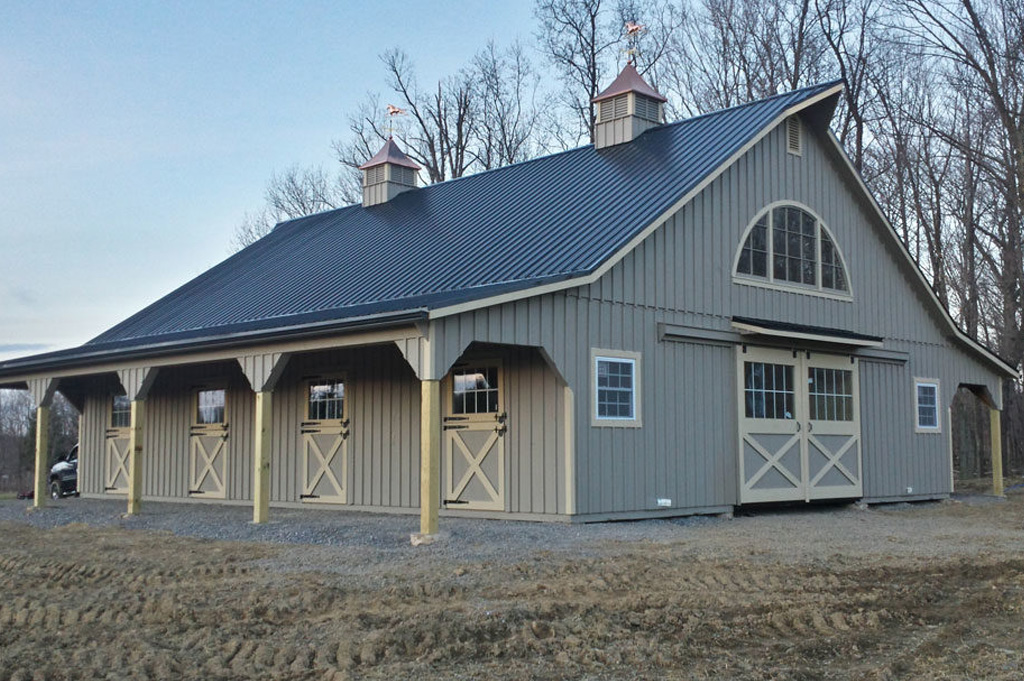
Shed row barns with luxury Sliding Stall Fronts in New York.
Secondly, shed row barns usually have fairly basic floor plans, which leads to barns that do not include luxury amenities such as extra tack rooms, lounges, and wash bays. One can spruce up a shed row barn's layout by adding an L-layout or U-layout that builds a courtyard. This particular design is prevalent throughout warmer climates from the southern United States to Latin America.
The decision between a center aisle barn and a shed row barn is ultimately particular to your horses, design goals, and project budget. Please feel free to contact our team if you have any questions. Our team has experience working with general contractors, builders, and architects nationwide. We can make recommendations based on your location.
Please feel free to email us at sales@americanstalls.com or call us at (855) 957 8255. Alternatively, you can complete a Contact Us Form.